

Why India's micro-communities persist, and who they leave out
Manisha [23], was getting married in Rajkot. When it came time to choose her bridal jewellery, her in-laws went to the jeweller and video-called her from the counter. They had already shortlisted a few designs, and she picked the ones she liked.
She chose the look, but her family had already decided almost everything else. They had settled how much gold would be bought, which pieces were compulsory, what her side would pay for, what his side would pay for, and what would count as enough.
On the surface, this was a thoroughly contemporary wedding, with a bride choosing her aesthetic over a video call. Underneath it sat a much older system of family, obligation, status and community.
The Plum
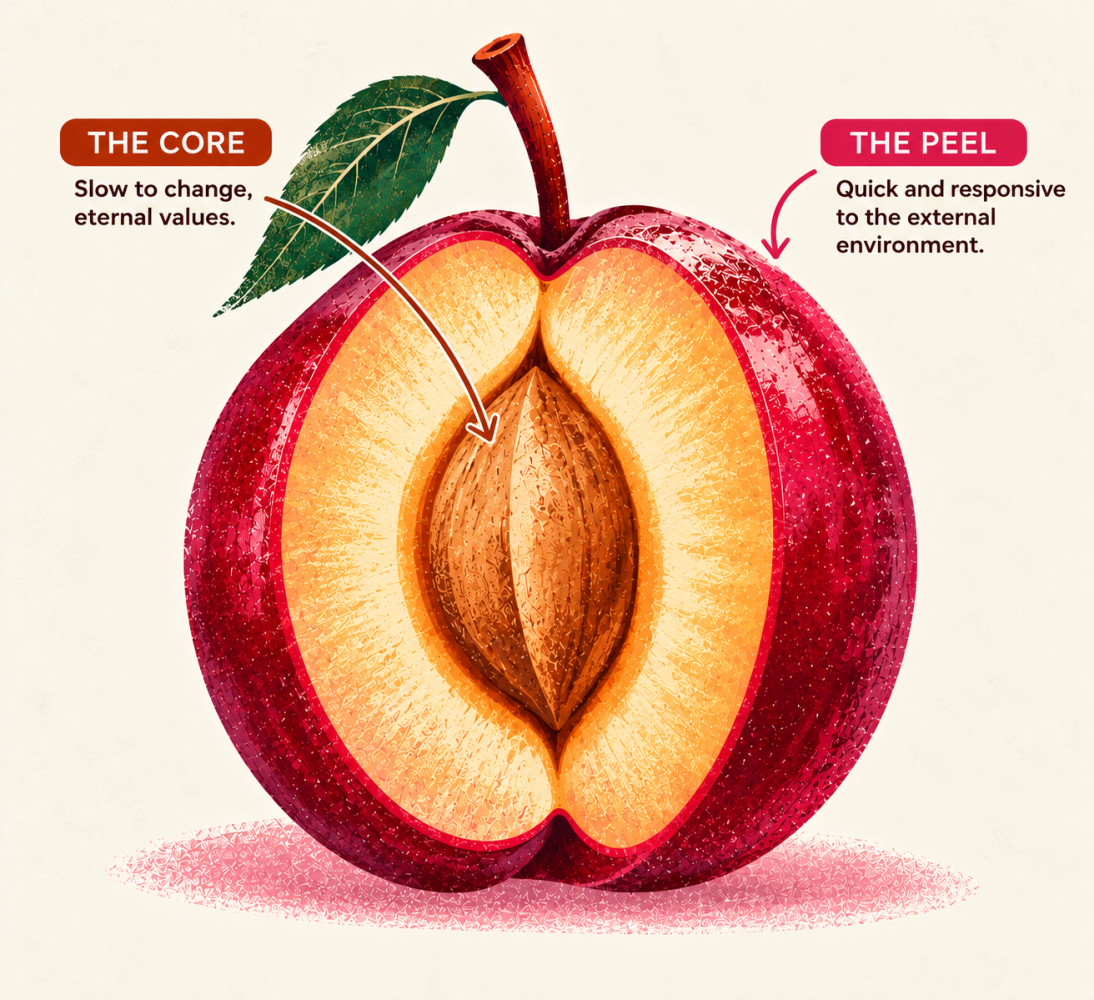
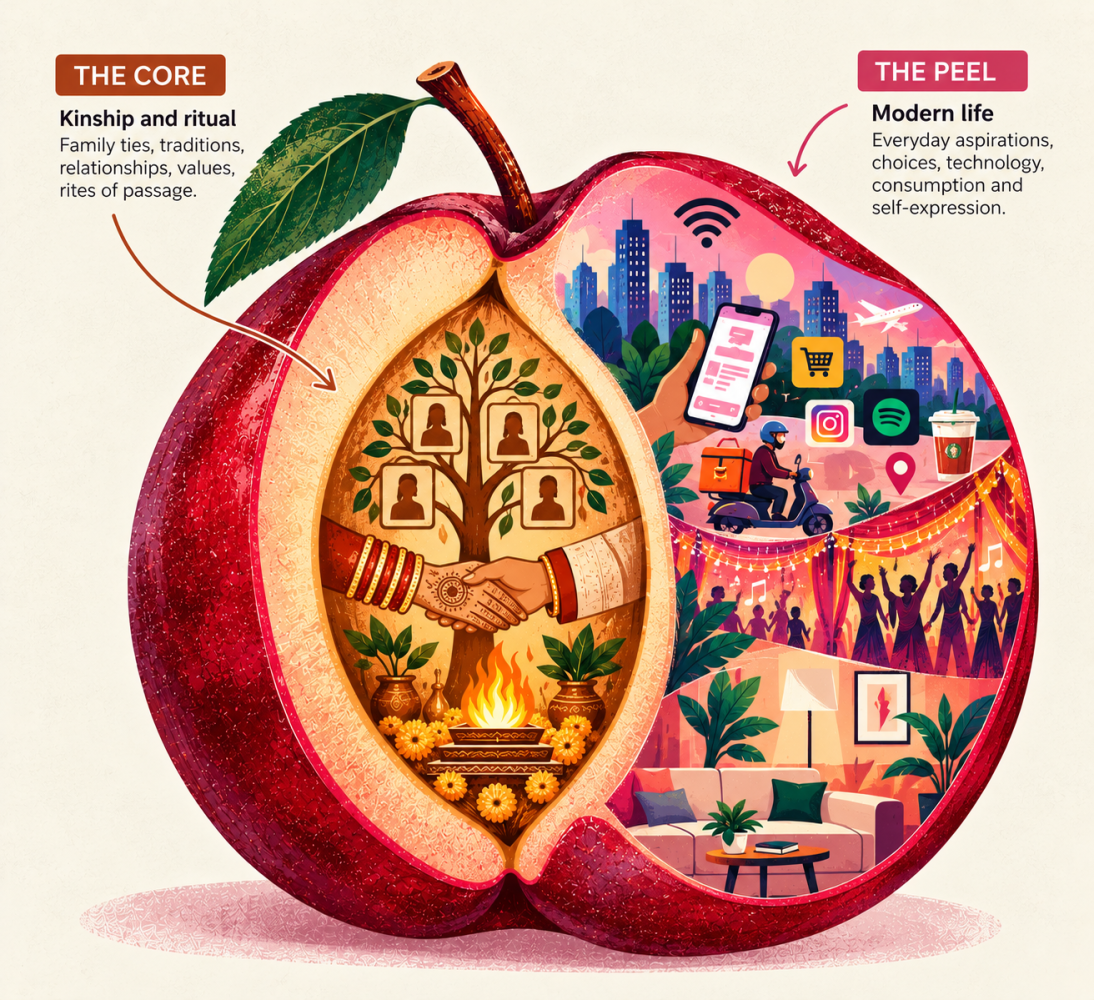
Cross-cultural researcher Fons Tropenaars popularised the concept of coconut vs. peach cultures. Asian cultures are described as peaches: soft on the outside, with a hard core at the centre. India might be better understood as a plum, whose skin changes quickly while its core changes slowly.
The skin is where new apps arrive, aesthetics shift, cuisines mix, wedding reels trend and brands enter. A ceremony can acquire a choreographed sangeet within a generation, and a ritual can move onto a smartphone almost overnight. Sri Mandir, a devotional app, now lets a family in Toronto book a puja at a temple in Varanasi. It has been downloaded around 40 million times, and a fifth of its revenue comes from the diaspora.
The core holds what reproduces itself over generations: kinship, marriage, ritual, inheritance and trust. But the core is not one thing. It contains belonging, continuity and hierarchy, braided so tightly that preserving one can reproduce another.
The India the shrug misses
If you ask a young professional in Mumbai or Bengaluru about their gotra (Hindu clan lineage) or their kuldevi (family goddess) or, you might get a shrug. It is tempting to read that shrug as evidence that these identities are no longer relevant today in modern India
Marriage records tell a different story. In Lokniti-CSDS's 2016 study of young Indians, acceptance of inter-caste marriage had risen from 31% to 55% in nine years, but only 4% of married respondents had actually married across caste, and 97% of arranged marriages took place within it. Opinions are moving much faster than practice. Roughly two-thirds of Indians also still live outside urban areas, where community becomes an orienting factor
The sociologist Satish Deshpande offers another reason to distrust the shrug. He argues that, for privileged castes, caste becomes least visible precisely when its advantages have already been converted into education, networks and jobs.
Let's be clear about what "community" can mean
When marketers talk about India's thousands of micro-communities, the language can sound warm. Community means belonging, shared food, festivals, jewellery, language and ritual, and the people who show up when you need them. All of that is real.
But in India, "community" also frequently means caste and sub-caste, and caste is not simply cultural difference. It is a system of social ranking that has historically decided who could own land, enter temples, draw water, marry whom, and even what people were permitted to wear.
Its effects have not vanished. In a 2016 survey by the SARI project, nearly two-thirds of respondents in rural Rajasthan and Uttar Pradesh, and more than a quarter of men surveyed in Delhi, reported that someone in their household practised untouchability. The bias also travels. The Employee Dharma Handbook, staged earlier this year by TheatreWorks Silicon Valley, follows a Dalit engineer passed over for promotion in favour of a less capable Brahmin colleague. As the San Francisco Chronicle put it, the play shows how an ancient bias still shapes an industry that prides itself on looking to the future. "I am caste-less," the Brahmin character insists, making Deshpande's point for him.
Any celebration of India's micro-communities therefore has to hold two truths at once. Community can be a thread that creates for belonging, and it can also be a wall that creates exclusion. Often it is both.
What sits inside the core
Marriage: where belonging reproduces itself
In 1916, B.R. Ambedkar argued that endogamy, or marrying within the group, was the mechanism that reproduces caste. While inter-community marriages are more and more commonplace in some parts, age old traditions persist in new forms in others. The ‘Aggarwal’ Samaj (a business community social gathering) has organised parichay sammelans, or mass matchmaking introductions, since 1978, and a single event in Jind in 2025 drew more than 1,500 candidates from 17 states.
Young people meet before agreeing, use dating apps and borrow their wedding aesthetics from Instagram. Some community leaders are even adapting the rules to keep the institution alive: the same Aggarwal Samaj organisers have proposed that women should no longer have to change their surnames. A community that survives through marriage keeps its walls through marriage too.
Food: intimacy with boundaries
In Pew Research Center's 2021 survey of nearly 30,000 Indians, 51% of Hindus and 72% of Jains said they would never eat in the home of someone whose religion has different food rules. Food carries affection and memory, but it also carries ideas of purity and pollution. In Mumbai, "vegetarian-only" buildings have spread since the 1980s, even though state law bars housing co-operatives from discriminating on the basis of food, religion or caste.
For brands, dietary rules can look like segmentation variables. For consumers, they are often moral systems.
Ritual and inheritance: culture made material
In Plum's fieldwork recently with to-be brides, the full bridal look did not end with the wedding day. Jewellery and clothing reappeared every year at festivals such as Gangaur in Rajasthan, Madhushravani in Bihar and Karwa Chauth in Uttar Pradesh. Jewellery worked almost like a family ledger, recording memory, wealth and obligation across generations.
That ledger is being renegotiated from the inside. "My parents prefer saving up first and then letting me buy the kind of jewellery I want," a bride-to-be in Kolkata told us. "The decision is entirely mine." It is also being rewritten in the same metal. With gold at record prices, some retailers told the World Gold Council that exchanging old gold accounted for up to 70% of their sales in 2026, as families melt heavy heirlooms into lighter designs.
Access to adornment has never been neutral either. In 1860 in Travancore, Arattupuzha Velayudha Panicker led an agitation for the right of lower-caste women to wear gold nose studs and other ornaments that had been reserved for upper castes. A necklace can be decoration, but for lower caste women the history can also represent age old it can also represent exclusion and prohibition.
Trust: the network beneath the network
The economists Kaivan Munshi and Mark Rosenzweig have shown that caste networks still act as informal insurance in rural India, helping members absorb shocks. The cover is valuable enough that households will forgo better-paid work in cities rather than lose it. The same logic built some of India's most successful trading networks. Palanpuri Jain families grew a global diamond business in Antwerp based on trusted community networks - with a strong self-regulated code of conduct that courts would find hard to enforce.
This is why the community persists. It is not merely a symbolic identity. It provides jobs, credit, introductions, suppliers, customers and emergency support. That creates a paradox: the stronger the network is for the people inside it, the more it costs to be outside it.
But the core can be rewritten
Persistence is only half the story. People do not simply inherit communities; they argue with them, reinterpret them, and sometimes build alternatives.
Ambedkarite Buddhist weddings deliberately remove the priest, the horoscope and the dowry from the ceremony. The couple light candles before portraits of the Buddha and Ambedkar and take vows that emphasise equality, and any respected person can officiate. The wedding remains, but its meaning changes. The same is true of inter-caste couples and of women who keep their surnames. For wedding brands, the opportunity is not to decide which version is authentic, but to serve both the inherited ritual and the chosen one.
The Dalit Indian Chamber of Commerce and Industry (DICCI), founded in 2005 and now with more than 10,000 members, builds the kind of business network that dominant communities have always had. Chamar Studio, founded in Dharavi in 2017, takes a word historically used as a caste slur and turns it into a label for design and craft, returning around half its earnings to artisans and a community foundation.
Change does not always mean abandoning the core. Sometimes it means rewriting it from within.
Many speeds, one country
The familiar metro-versus-Bharat story assumes that social change starts in Mumbai and Bengaluru and spreads outward. The community does not behave so neatly. A 2017 Indian Statistical Institute study of national survey data found inter-caste marriage was no more common in urban India (about 5.0%) than in rural India (about 5.2%). A 2021 study that mapped 147 Indian cities block by block, using census data, found that the largest are among the most segregated by caste.
The difference is visibility. In smaller places, community is explicit: the samaj hall, the family jeweller, the neighbours who know your grandmother. In cities, it becomes infrastructural, built into the housing society, the alumni network, the family WhatsApp group, the matrimony filter and the "someone like us" recommendation.
This matters commercially. The World Economic Forum projects that 93% of the growth in India's urban consumer class through 2040 will come from outside the five largest cities, where community shapes daily life most openly.
Where brands get it wrong
Brands that wander into this territory without understanding it tend to fail in one of two ways.
The first is reproducing the hierarchy without noticing. On World Environment Day in 2023, Zomato released an ad featuring Kachra, the Dalit character from the film Lagaan, being used as a stool, a lamp and a towel to promote recycling. The filmmaker Neeraj Ghaywan called it "extremely insensitive", and Zomato took it down three days later, saying it "may have hurt the sentiments of certain communities". In 2020, a Kent appliance ad asked, "Are you allowing your maid to knead atta dough by hand? Her hands may be infected." Critics pointed out that it dressed up old ideas of caste purity as pandemic hygiene, and Kent withdrew it within a day. In both cases, the people who made the ad seem not to have seen what it was saying, perhaps because they had never been on the receiving end of it.
The second is backing the rewrite without being ready to defend it. In October 2020, Tanishq's Ekatvam film showed a Muslim family hosting a traditional baby shower for their Hindu daughter-in-law. After a boycott campaign, the brand withdrew it within four days, citing the "well-being of our employees, partners and store staff". It was then criticised by the other side for backing down. The core pushes back hardest when a brand shows it changing, and a brand that steps into that space needs to decide in advance whether it will stay.
The watch out is simple. If a campaign touches marriage, food, purity, or who serves whom, test it with people from the communities it depicts before launch, not after the backlash.
How might we…
Brands do not need to become experts in thousands of castes and communities. Trying to do so can inadvertently turn cultural understanding into profiling. The better question is how to serve belonging without serving hierarchy.
1. SERVE: how do we serve in a way that unites and not furthers the divide? Makes people feel respected rather than different
McDonald's India adapted to deeply held food practices from the start. It removed beef and pork from the menu, separated vegetarian and non-vegetarian preparation into different kitchens in every restaurant, and later added Jain options without onion or garlic. The system changed to accommodate the person following the rule, without asking anyone else to declare anything.
Zomato's 2024 "Pure Veg" fleet began from the same need, but its riders were initially to wear green uniforms instead of the usual red. Critics warned that visibly marking vegetarian deliveries could invite discrimination against riders and households. Zomato reversed the uniforms within a day and kept the vegetarian option as a filter inside the app.
Ask: Are we meeting this rule for the person who follows it, or are we making it visible to everyone else?
2. SEE: How might we recognise community differences without profiling people?
Within the same city, two households with similar incomes can have completely different rules around food, marriage, gifting and worship. Kalyan Jewellers pairs national ambassadors with state-level faces and a regionally localised bridal line. Matrimony platforms go further, letting users choose the community they want to search within.
The harder frontier is data. Writing in The India Forum in 2026, researchers described how hiring and lending models can reconstruct caste from a surname, neighbourhood, college or father's occupation, even after names are removed. Brands should understand the communities that people choose to identify with. They should be far more cautious about systems that infer identity silently and use it to decide who sees an offer or who receives credit.
Ask: Did this person tell us who they are, or did our system decide for them?
3. WIDEN: How might we build for people whose inherited networks do not reach?
If a community works as infrastructure, the deeper opportunity lies in what those networks provide (credit, insurance, introductions, suppliers and customers) and in who goes without them.The government's Stand-Up India scheme, launched in 2016, was designed for exactly this gap: it asks every bank branch to lend to at least one Scheduled Caste or Scheduled Tribe entrepreneur and at least one woman entrepreneur. By 2025, it had made about 61,000 loans to SC and ST borrowers. That is a good start, but it is small for communities of more than 300 million people, and the demand that DICCI organises suggests how much room there is to grow.
Ask: Who gets access here because they already belong to the right network, and what could we build so that belonging is no longer the price of entry?
4. LOOK INWARD: How might we make sure the people studying and building for India aren't all from the same core?
Consumer research usually recruits by city, age, gender and income, and rarely asks whose community is missing. Teams, agencies and supplier lists often look similar. When everyone interpreting India comes from roughly the same social world, there is a risk of one group's experience becoming "the Indian consumer". The Tata Group has run an affirmative action programme for Scheduled Caste and Scheduled Tribe communities since 2007, covering hiring, scholarships and supplier development, which shows the problem can be addressed deliberately.
Ask: Whose reality is missing from our sample?
Modern India changes its skin every season. Its core changes over generations. Brands need to know which one they are dealing with, whose core it is, and who it leaves out.
Reply and tell us: where in your category have you seen the core hold, or be rewritten?
Plum Insights helps brands decode the cultural systems behind everyday choices, from ritual and kinship to identity and exclusion. Write to us at hello@plum-insights.com.
Sources
TechCrunch, Sri Mandir (2025): https://techcrunch.com/2025/06/30/sri-mandir-keeps-investors-hooked-as-digital-devotion-grows
- Lokniti-CSDS/KAS Youth Study (2016–17): https://www.lokniti.org/media/upload_files/KeyfindingsfromtheYouthStudy.pdf
- World Bank urban share (2024): https://tradingeconomics.com/india/urban-population-percent-of-total-wb-data.html
- Satish Deshpande, "Caste and Castelessness", EPW (2013): https://www.epw.in/journal/2013/15/perspectives/caste-and-castelessness.html
- Coffey, Hathi, Khurana & Thorat, SARI survey, via Scroll: https://scroll.in/latest/864755/untouchability-still-high-in-uttar-pradesh-rajasthan-and-delhi-finds-survey
- Thorat & Attewell, "The Legacy of Social Exclusion", EPW (2007): https://akscusa.org/wp-content/uploads/2020/08/ThoratAttwellSocialExclusion.pdf
- NCRB Crime in India 2023, via The Wire: https://m.thewire.in/article/society/crimes-against-sts-cybercrimes-surged-in-2023-ncrb-report
- B.R. Ambedkar, Castes in India (1916): https://franpritchett.com/00ambedkar/txt_ambedkar_castes.html
- Matrimony.com annual report: https://www.matrimony.com/sites/default/files/newsroom-assets/2023-01/matrimonycom-ltd-annual-report-2019-20.pdf
- ThePrint, Aggarwal parichay sammelans (Sept 2025): https://theprint.in/ground-reports/the-aggarwal-crisis-in-india-they-have-everything-but-no-one-good-to-marry/2744117/
- Pew Research Center, religion and food (2021): https://www.pewresearch.org/religion/2021/06/29/religion-and-food/
- Outlook, vegetarian-only housing in Mumbai: https://www.outlookindia.com/national/food-apartheid-non-vegetarians-not-allowed--magazine-192445
- World Gold Council, Gold Demand Trends: India Focus Q2 2026: https://www.gold.org/goldhub/research/gold-demand-trends/gold-demand-trends-india-focus-q2-2026
- Arattupuzha Velayudha Panicker / 1860 nose-stud agitation: https://en.wikipedia.org/wiki/Arattupuzha_Velayudha_Panicker
- Munshi & Rosenzweig, caste networks and migration: https://voxdev.org/topic/labour-markets/caste-and-economic-mobility-india
- The Conversation, Palanpuri diamond traders in Antwerp: https://theconversation.com/the-rise-and-rise-of-belgiums-indian-diamond-dynasties-32332
- ThePrint, Ambedkarite Buddhist weddings (2023): https://theprint.in/ground-reports/made-in-heaven-made-india-curious-about-dalit-buddhist-weddings-this-is-how-they-happen/1754900/
- DICCI: https://en.wikipedia.org/wiki/Dalit_Indian_Chamber_of_Commerce_and_Industry
- The Better India, Chamar Studio: https://thebetterindia.com/252239/dharavi-leather-artisans-sudheer-rajbhar-chamar-studio-eco-friendly-designer-wear-bags-wallet-shoes-recycled-rubber-caste-india-div200/
- Ray, Chaudhuri & Sahai (ISI, 2017): http://piketty.pse.ens.fr/files/Rayetal2017.pdf
- Bharathi, Malghan, Mishra & Rahman, residential segregation: https://www.ideasforindia.in/topics/urbanisation/residential-segregation-in-urban-india-and-persistence-of-caste-i
- WEF (Feb 2026): https://www.weforum.org/stories/2026/02/massive-urban-shift-in-india-consumer-growth-decentralizing/
- McDonald's India, separate kitchens: https://x.com/mcdonaldsindia/status/1676303707359821826 ; Jain menu: https://mcdonaldsblog.in/2023/06/introducing-mcdonalds-jain-friendly-menu/
- CNN, Zomato "pure veg" fleet (2024): https://www.cnn.com/2024/03/21/business/india-zomato-pure-vegetarian-fleet-controversy-intl-hnk/index.html
- exchange4media, Kalyan regional ambassadors: https://www.exchange4media.com/marketing-news/kalyan-jewellers-signs-new-brand-ambassadors-in-four-key-markets-97176.html
- The India Forum, "Algorithms Don't Need Your Surname to Guess Your Caste" (March 2026): https://www.theindiaforum.in/caste/algorithms-dont-need-your-surname-guess-your-caste-thats-problem
- Free Press Journal, Stand-Up India sanctions (2025): https://www.freepressjournal.in/business/stand-up-india-scheme-sees-sanctions-cross-61000-crore-mark-boosts-sc-st-and-women-entrepreneurs
- Tata Affirmative Action Programme: https://www.tata.com/careers/affirmative-action
- Plum Insights fieldwork, 2026.