

A nine-year-old watches a YouTube video about protein in snacks. The next morning, she tells her mother the biscuits in the kitchen have "bad ingredients." By the next grocery order, her mother is considering another brand.
The child has no income. She does not do the grocery shopping. She may not know what the biscuits cost. But she has already influenced what enters the house.
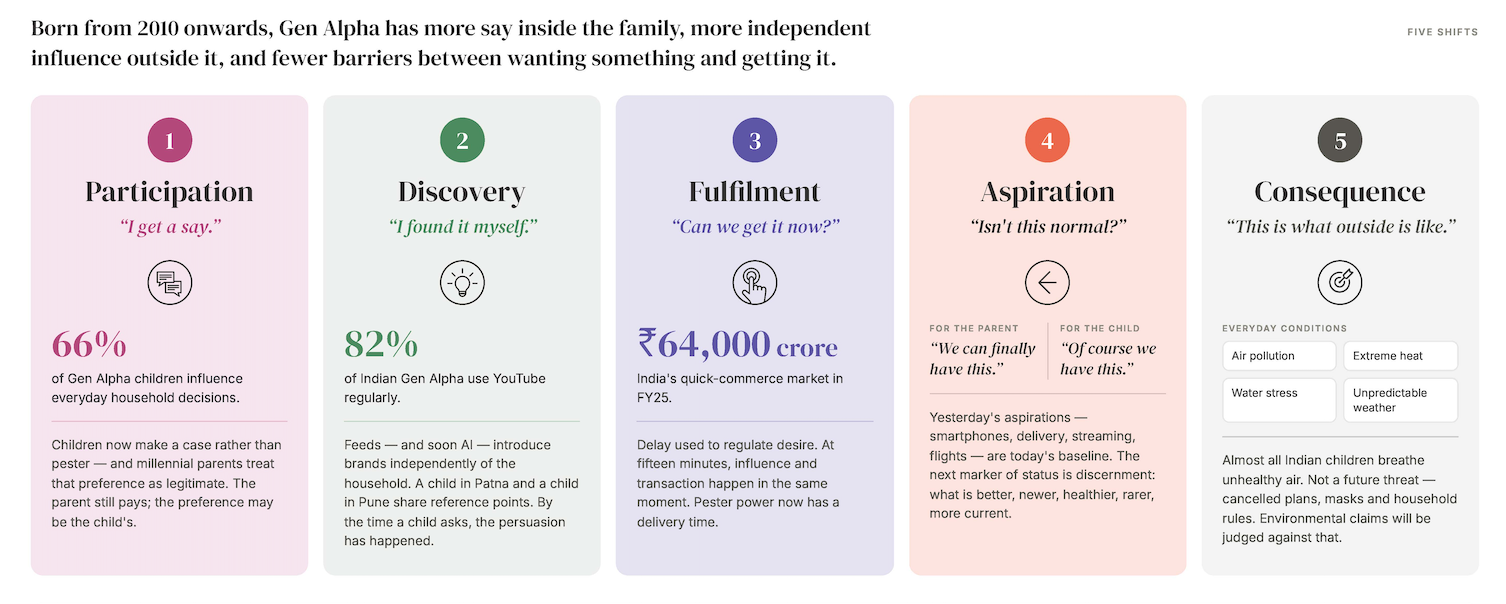
This is what makes India's Gen Alpha interesting. Born from 2010 onwards, they are growing up with more say inside the family, more independent sources of influence outside it, and fewer barriers between wanting something and getting it.
They are not simply younger Gen Z. Gen Z encountered smartphones, social media and algorithms as they grew up. Gen Alpha was born into them. AI will be less a technology they adopted than infrastructure they inherited.
The result is a generation acquiring consumer power long before it acquires purchasing power. We see five shifts changing how that power is formed and exercised.
1. Participation: "I get a say"
Indian children are moving closer to the centre of household decision-making. 66% of Gen Alpha children influence everyday household decisions, from what gets eaten and watched to where families go and what they buy.
The more interesting change is not simply that children ask for things. It is that they are learning to make a case for them. They wait for the right moment, reason with parents and return to the conversation after being told no.
This reflects a wider change inside the Indian family. Millennial parents are more likely to ask for opinions, explain decisions and treat children as participants in choices that previous generations largely made for them.
Pester power assumed an adult held the decision and a child tried to wear them down. Participation is different. It gives the child's preference legitimacy.
For brands, this creates a second audience inside the household. The parent may still make the purchase, but the preference may have been formed by the child.
2. Discovery: "I found it myself"
Gen Alpha does not need a parent, television commercial or supermarket aisle to introduce it to a brand.
YouTube is already a regular part of life for 82% of Indian Gen Alpha, carrying everything from gaming and music to food, dance, entertainment and learning into everyday life.
A child in Patna and a child in Pune can now grow up with surprisingly similar reference points. Their physical worlds may be different; their feeds increasingly overlap.
Algorithms change something else too. They give children a space in which discovery happens independently of the household. A recommendation can introduce a game, snack, skincare ingredient, footballer or Korean food trend before a parent even knows it exists.
AI will accelerate this. For adults, AI is still something to learn, adopt or debate. For this generation, asking a machine for an answer, recommendation or creation may become as ordinary as searching Google was for the generation before them.
This changes the point at which brands need to compete. By the time a child asks for something, the persuasion may already have happened.
3. Fulfilment: "Can we get it now?"
A child's request once had to survive several layers of friction: remember it until the weekend, convince the parent, reach the shop, find the product and hope it was in stock.
Much of that friction is disappearing.
India's quick-commerce market reached roughly ₹64,000 crore in FY25. But the more consequential change is behavioural: the distance between a child's desire and a parent's ability to fulfil it has collapsed.
See it. I want it. Ask for it. Tap. Doorbell. Pester power now has a delivery time.
Delay used to regulate desire. "We'll see when we go to the shop" gave a request hours or days to disappear. When fulfillment takes fifteen minutes, influence and transaction can happen almost in the same moment.
For brands, quick commerce is therefore not simply another distribution channel. It changes which products become impulse purchases, what needs to be recognizable on a small screen, which pack sizes make sense and how quickly cultural attention can turn into household consumption.
4. Aspiration: "Isn't this normal?"
Gen Alpha is also inheriting a different definition of normal.
Many of the things their parents experienced as markers of progress—branded staples, smartphones, food delivery, streaming subscriptions, malls, flights and global entertainment—are simply part of the environment some Gen Alpha children arrived into.
This shift is particularly interesting beyond the metros. A parent in a Tier 2 or Tier 3 city may remember the first international brand, supermarket or app entering the household. Their child experiences many of these things as baseline.
Aspiration does not disappear when yesterday's aspiration becomes normal. It moves.
The next marker of status may therefore be less about access and more about discernment: knowing what is better, newer, healthier, rarer or more culturally current.
Yet this is not a generation growing up without financial pressure. Children also overhear conversations about tuition, household expenses and what things cost. Global reference points can coexist with an intensely practical understanding of value.
For brands, premium will increasingly need to mean more than access to what was once scarce. The question becomes what feels distinctive to a generation for whom much of yesterday's premium has become ordinary.
5. Consequence: "This is what outside is like"
Some of the crises previous generations learned about as future threats have entered Gen Alpha's childhood as everyday conditions.
Almost all Indian children are exposed to unhealthy levels of air pollution, alongside growing exposure to extreme heat, water stress and other climate risks.
These are not statistics about a future problem. They are descriptions of a present childhood.
A child who checks the air-quality index before going outside does not experience pollution as an environmental issue in the abstract. It is the reason sport moves indoors, a mask appears in the school bag or a parent says no to playing outside.
The same is true of heat and water. They are experienced first as cancelled plans, changed routines, physical discomfort and household rules—and only later as "climate change."
That may create a different relationship with sustainability as this generation grows older. Environmental claims will be judged against conditions they have experienced physically, not simply understood intellectually.
The implication is not that every child will become a climate activist. It is that a generation growing up inside the consequences may have less patience for brands that communicate responsibility more convincingly than they demonstrate it.
These five shifts are beginning to change where consumer influence starts.
A child discovers a product through YouTube or a creator, arrives at the family conversation with an opinion already formed, negotiates with a parent who expects that opinion to be expressed, and can see the product arrive at the door fifteen minutes later.
The purchase still belongs to the adult. Increasingly, the preference does not.
This is why Gen Alpha should matter to brands before it becomes an independently spending cohort. Food, beauty, entertainment, travel, fashion, technology and even household categories are already being encountered through a second pair of eyes.
But there is a deeper shift here too. Influence inside the family has traditionally been imagined as moving downwards: parents introduce children to products, habits, tastes and ideas about what is worth buying.
Increasingly, some of that influence is travelling the other way.
Children introduce parents to creators, ingredients, games, language, aesthetics and products they encountered elsewhere. They bring the outside world into the household, often before the adults around them have caught up with it.
Gen Alpha is not waiting to become a consumer. It is already changing the behaviour of consumers around it.
What is Gen Alpha already teaching its parents to want?
Plum Insights explores how emerging generations reshape household choices, category expectations and the meaning of aspiration.
Write to us at hello@plum-insights.com
Sources
Rukam Capital, Gen Alpha Decoded (2026) — Gen Alpha's influence on household decisions and digital behaviours.
Redseer Strategy Consultants (2026) — India's quick-commerce market size and growth.
UNICEF, Children's Climate Risk research — Indian children's exposure to air pollution and multiple climate and environmental hazards.
Previously on Plum Peels
Five ways Indian consumers are adapting to a changed climate, September 2026
The Leapfrog Consumer, July 2026
Everything, all at once: Why subculture means something different in India, June 2026