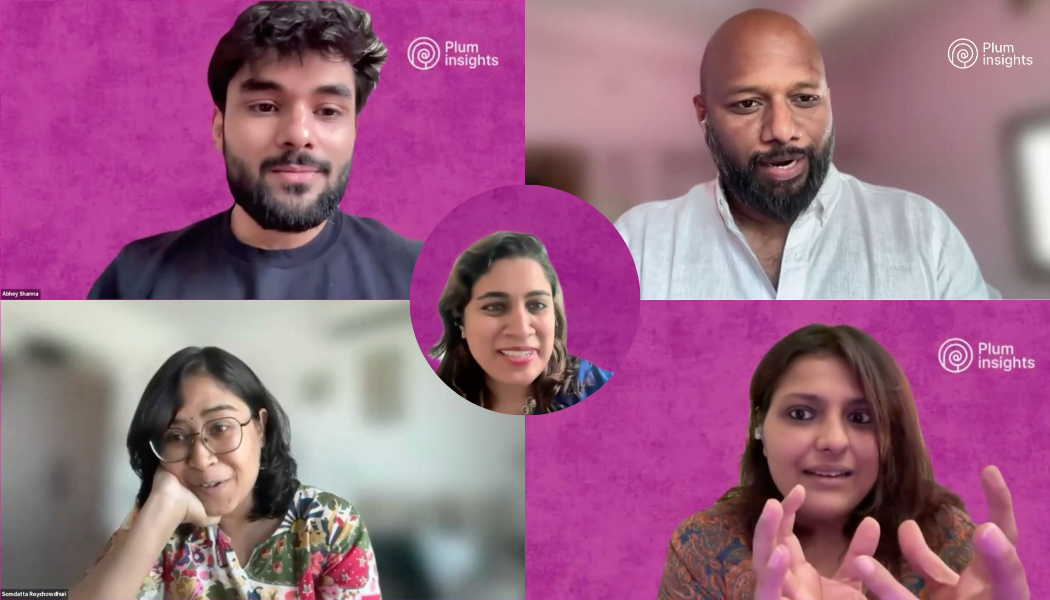
Ne presented our research on contemporary Indian masculinity in a live webinar, followed by a panel with four people who think about men for a living - a gender practitioner, an emotional well-being community founder, a journalist, and a senior brand planner. This piece is what we took away.
The Performance Trap
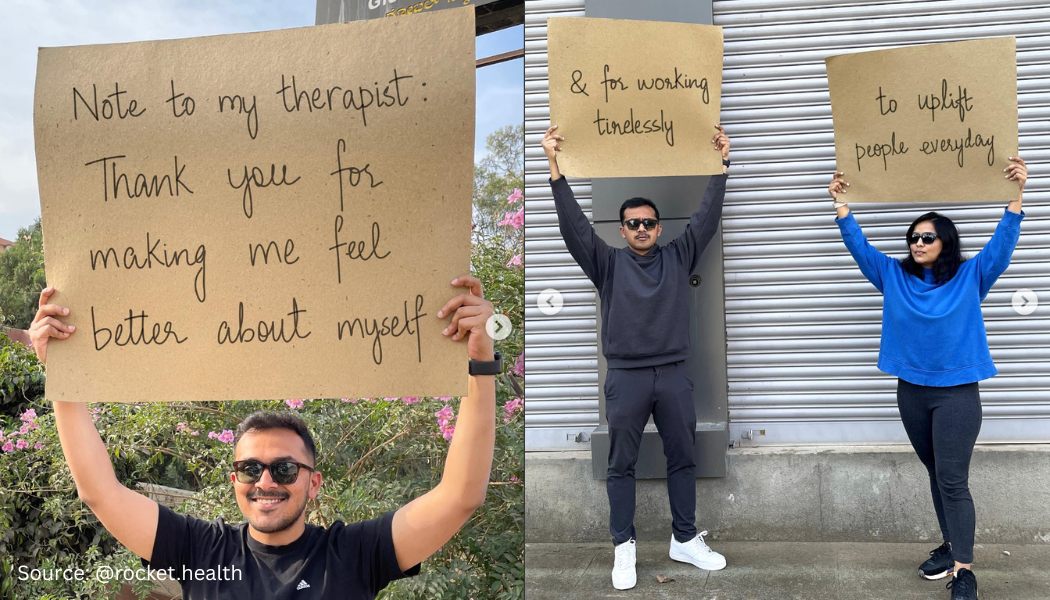
There is a reel circulating this year of a 28-year-old holding up a cardboard sign: "Note to my therapist - thank you for making me feel better about myself." It is a tender moment, broadcast to strangers. And that is the point.
Masculinity in India has moved from something a man is to something he performs. The silent provider has been replaced by the visible one - the fitness grid, the money reel, the therapy confession, the grooming routine with a six-step voiceover. Being a man used to be private. It is now constantly evaluated, compared, and optimised in public view.
As Sneha Chaturvedi, co-founder of Slide, put it on our panel: "The core codes of masculinity have not changed as much as we think. The codes have stayed - how they're being performed has changed." Men know the ideal. They are just performing it on a platform their fathers never had to play on.
The Identity Stretch
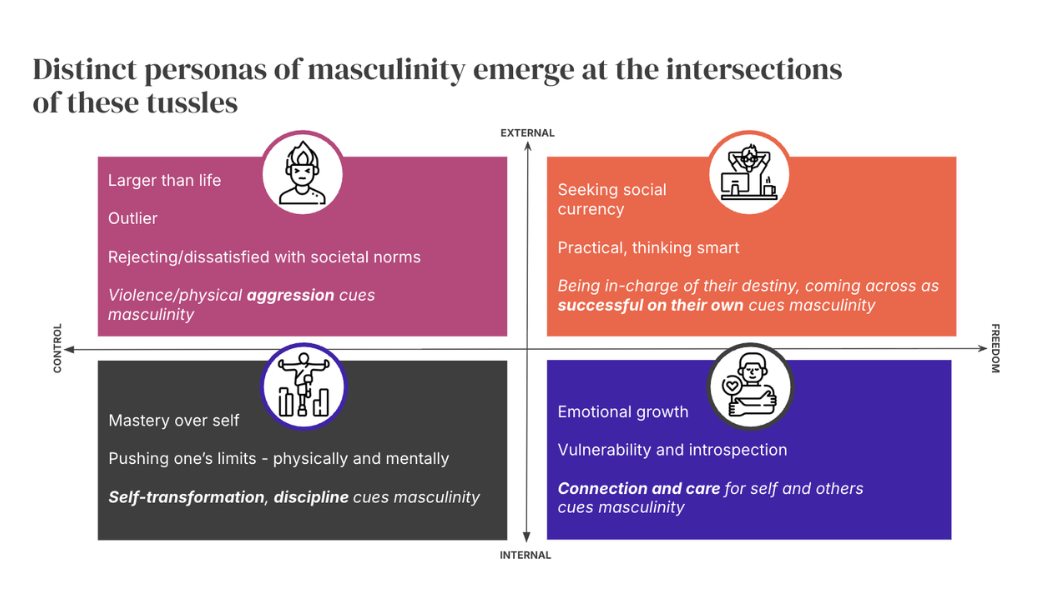
Today's Indian man is expected to be strong and soft. Provider and partner. In control and emotionally open. Our research maps five archetypes across two tensions - control versus freedom, and internal versus external - and what becomes clear is that these are not sequential stages of an evolution. They are simultaneous expectations.
The Raw Rebel channels unfiltered intensity outward: the Beardo man, Kabir Singh, Ranvijay in Animal. The New Age Warrior turns that same intensity inward, optimising his body into submission: Hyrox, MuscleBlaze, 3-minute cryotherapy. The Refined Everyday Man uses grooming as a locus of control: Traya, Gillette, the +100 aura reel. The Optimiser designs his way out of the grind: The Sleep Company, Airbnb, "break the 9-5." The Tender Man admits he needs the hug: Myntra's Bromance, Rocket Health, indē wild.
The data underneath is the complication. Women's labour-force participation rose from 23.3% to 41.7% between 2017-18 and 2023-24. Women's higher-education enrolment has exceeded men's for five straight years. Yet 80% of Indians still agree that when jobs are scarce, men should have first claim. Women spend 299 minutes a day on unpaid domestic work; men spend 97.
The Inner Void
Beneath the performance and the archetype-hopping, something quieter is happening. The question Indian men are asking has shifted from "how do I get ahead?" to "am I enough?"
Abhey Sharma, founder of MenDoFeel, an online community for men's growth, has watched this turn in real time. "Every conversation around women starts with 'how can I get this girl?'" he told us. "But sooner or later, it changes to: am I enough? Am I worthy enough? Have I done something enough to make my parents proud?"
The data backs the qualitative. Gen Z men in India report more loneliness associated with their gender than women do. Men make up over 70% of recorded suicides. Tele-MANAS has handled more than 32 lakh calls since its national scale-up. Emotional expression is finding outlets - memes, irony, the viral therapy reel - but safe formats for actual vulnerability remain thin.
Indian men today are overexposed externally and underdeveloped emotionally. Asking more of themselves. Equipped to process it less.
The Search for New Masculinities
So what is emerging is not a new Indian man. It is a modular one.
Somdatta Roychowdhuri, Senior Brand Planning Director at FCB Interface, named it precisely: "The pressure to be one kind of man has disappeared. It's becoming more and more modular. They can be a gym bro at 7 AM, and a very articulate partner in the evening. It's being performed situationally."
This is the white space - for storytelling, for category work, for brand building. Not the extreme archetype. The messy middle. The becoming, not the being. The transitional part, where the answer being prescribed does not quite work.
What this means for brands
1. Stop picking an archetype. Build for the rotation. Most brands still write to one archetype at a time. The consumer is all five, badly, across a single week. The win is not in picking the right archetype - it is in building a brand world that holds the contradiction.
2. Shift the locus from ideal to effort. Somdatta's sharpest observation, drawn from a recent Axe campaign: "Muscle was a masculine code at one point. The muscle is now being changed to effort - the effort he's taking to improve himself, to unlearn, to be more sensitive to other people." The man who has not figured it out and is trying is the aspirational figure. Not the one who has.
3. Build for male-only ecosystems, not men-in-relation-to-women. Indian advertising has done male-female portrayals well. Male-male is the gap. How does new masculinity play out in friendships, locker room conversations, group chats? McDowell's, Myntra and Cadbury have started here. The room for category play is large.
4. Give men a why, not just a what. Campaigns that moralise to men without offering them a version of themselves they want to be have already peaked. Vivek Surendran, writing on modern male life, put the inheritance bluntly: "Men have been raised to function in a system that rewards performance over presence." The opportunity is in showing men what they gain from a new script, not what they owe.
The question we are sitting with: If masculinity in India is no longer moving in one direction, what is your brand's theory of which direction your consumer is moving in this week?
Read the full report 📖
Watch the webinar recording with Abhey Sharma (MenDoFeel), Sneha Chaturvedi (Slide), Vivek Surendran (Journalist) and Somdatta Roychowdhuri (FCB Interface).
Watch webinar recording 🎙️
If this sparked a conversation, a thought, or a brief - we would love to hear from you. hello@plum-insights.com