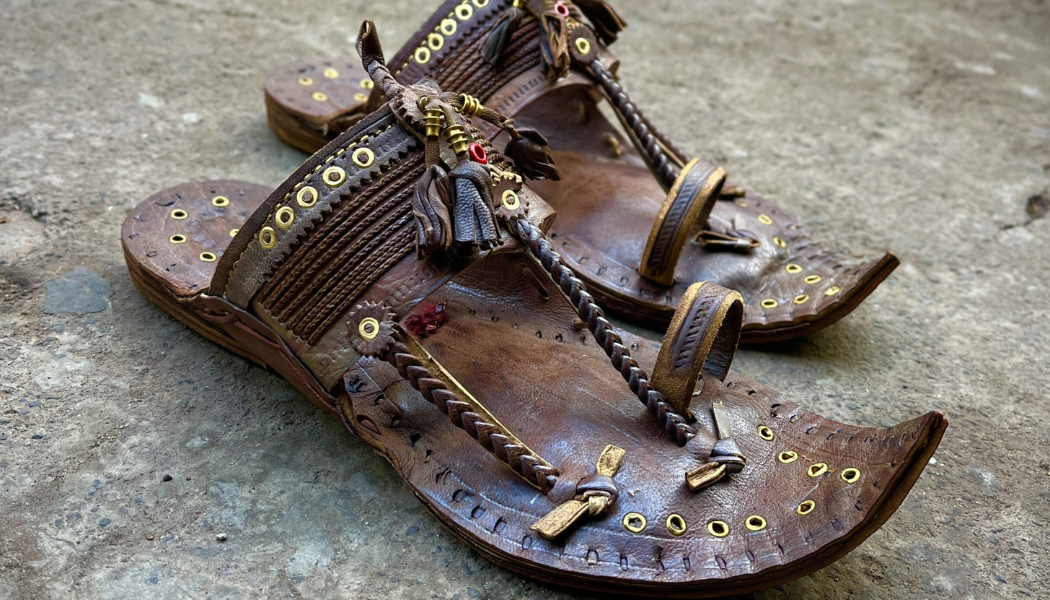
On 22 June 2025 Prada’s Spring/Summer ’26 menswear show in Milan sent a ₹1.2-lakh (~US$1,390) “toe-ring sandal” down the runway. Indian timelines flashed red: the silhouette was the Kolhapuri chappal, a leather slipper that costs barely ₹300 (~US$3.50) in its hometown. Viral side-by-side shots sparked outrage; within forty-eight hours Kolhapuri artisans threatened legal action under the craft’s Geographical-Indication tag, the Maharashtra government weighed in, and Prada’s supply-chain chief hurried to Mumbai to negotiate a collaboration. Business media chronicled every twist, turning one look into a global cautionary tale.
Why the Kolhapuri Matters
A craft rooted in twelfth-century Kolhapur
Origin stories trace the sandal to Lingayat cobblers patronised by King Bijjala and Chhatrapati Shahu I. Still cut from vegetable-tanned buffalo hide and fixed with brass pins, the shoe earned a Geographical-Indication (GI) tag in 2019 that binds authentic production to eight districts across Maharashtra and Karnataka. On city pavements it costs less than a pizza; export boutiques may ask ₹4,000 (~US$46). Prada’s hundred-fold markup, launched without naming Kolhapur, sounded less like luxury than daylight extraction.
The Bigger Cultural Turn: From Windows to Mirrors
A nation wants reflection, not reference
For decades Indians peered through Western windows for cues on modern and aspirational taste. In 2025, the gaze flips to mirrors of local pride. Last November the United States returned more than 1,400 looted Indian artefacts worth ten million dollars, a headline framed as cultural self-determination. Hindi cinema’s box-office share slipped to forty percent in 2024 while Telugu and Kannada films surged, ending the old North-centric monoculture. Four in five Gen Z Indians now trust micro-influencers over celebrities, rewarding voices who speak their dialects and shop their lanes. Brands are answering with Tamil beauty reels and Marathi WhatsApp bots.
The New Rules of Cultural Credit
Four principles reshaping ownership:
- Provenance outruns product: If a label stays silent about its inspiration, social media will name it and cry theft within hours.
- Price-point dissonance fuels pride: A ₹300 (~US$3.50) object reborn at ₹1 lakh (~US$1,160) converts private irritation into collective fury because the maths is so stark.
- Geographical-Indication tags, once dusty paperwork, now lend instant legal gravitas to outrage and tempt politicians looking for soft-power wins.
- Most of all, consumers are collaborators. The same people who covet designer goods will file petitions, post evidence grids and lobby officials; they expect to co-author the narrative and punish any brand that edits them out.
Prada’s belated talks with certified makers show the cost of treating artisans as ornamental rather than integral.

Brand Playbook
Co-design, transparency, hyper-local voices
What if co-design began at concept stage, with artisan clusters present in the mood-board room instead of waiting for a post-crisis apology tour? Where a premium is unavoidable, brands must unpack the maths - craft hours, living-wage increments, vegetable-tanning costs, limited runs - so the uplift reads as value creation, not extraction.
They need a lattice of hyper-local voices - Kolhapur vloggers, Kannada fashion critics, Marathi Instagram historians - to sanity-check motifs before launch and later carry the story with credibility. And cultural-IP audits must become as routine as trademark searches; a week of diligence beats a day of global ridicule.
How Might We…
Prototype co-authored futures
Turn luxury into a provenance platform: Imagine a Prada × Paytaan sandal whose in-store screen streams the Kolhapur workshop and a QR ledger pays resale royalties to artisans.
Democratise heritage for Gen Z: Pop-up kiosks capped at ₹500 (~US$5.80) could pair Kolhapuris with steel tiffins and gamcha totes, each item tagged with a scannable origin story and a tip jar for cooperatives.
Build a creator constellation that shields integrity: Dashboards weighting relevance over reach can surface a Kolhapur schoolteacher with fifty-thousand engaged followers or a Dharwad leather-worker on reels, inviting them into pre-launch reviews forms a living cultural firewall and a narrative network at launch.
What’s one everyday object whose story you wish brands told better?
Write to us at hello@plum-insights.com
Until next time, Team Plum 🍑
Loved this edition?
Follow us for more India-first insights into evolving consumer culture! Want to share your thoughts or suggest a topic?
Previously on Plum Peels
How India is Rethinking Money (June, 2025) - Click to read Indian investing is shifting from caution to self-authorship. Across cities, people are using money to build trust with themselves, not just wealth. In this edition, we unpack the emotional logic behind the numbers.
Reclaiming the Everyday (May, 2025) - Click to read How India’s affluent consumers are turning toward neem, composting, and khadi — not for nostalgia, but for sovereignty.